

- This event has passed.
The Many Colors of Galaxies: YOU Can Help NASA Decode the Cosmos
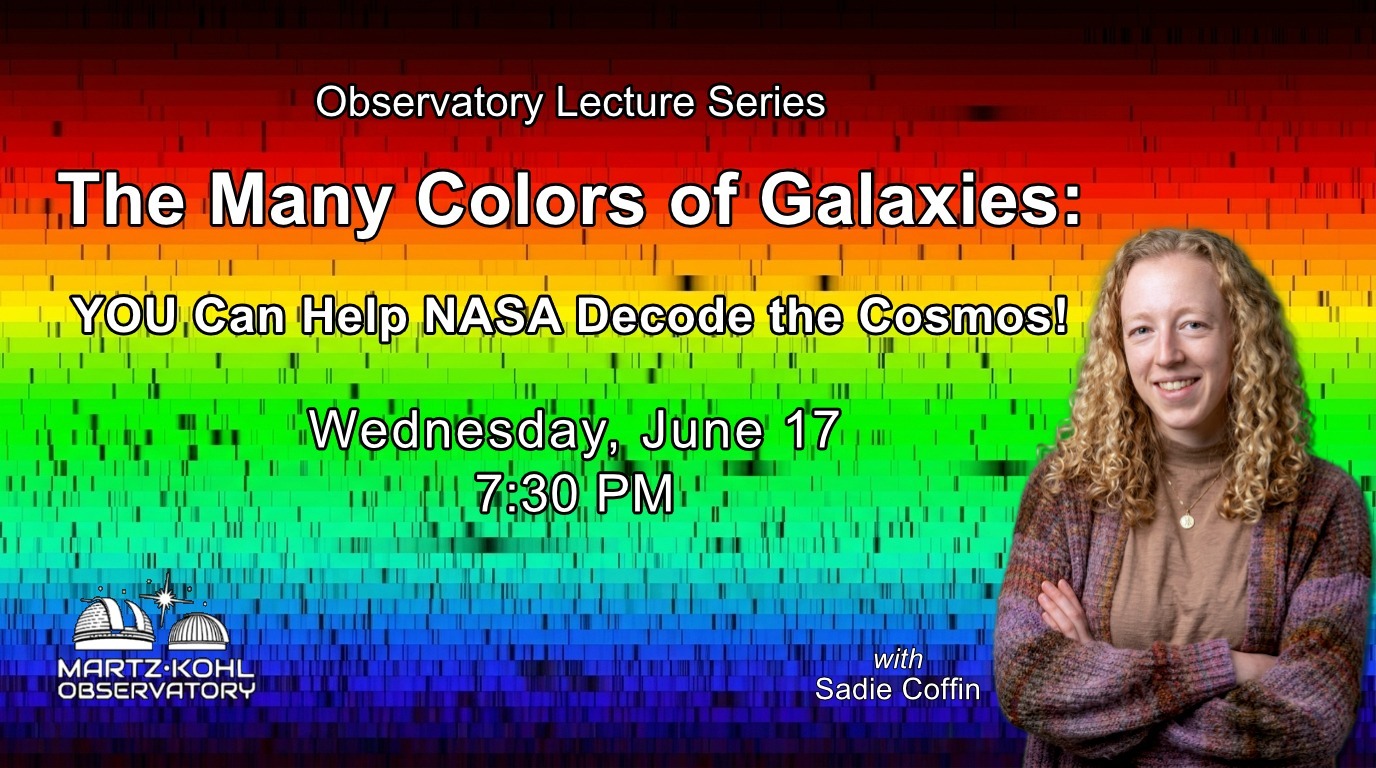
How do galaxies grow and change over time, and how can we tell from just a few lines of light?
We are pleased to host Rochester Institute of Technology (RIT) astrophysicist and PhD candidate Sadie Coffin for an engaging presentation on galaxy evolution and participatory science.
Coffin will explain how the unique lines in galaxy spectra serve as records of the Universe’s history, acting as a cosmic time machine to track how distant galaxies interact, evolve, and form stars over deep time. By analyzing these spectral features, astronomers can decode the complex properties of entire galaxy systems.
Her doctoral research bridges the gap between complex galaxy spectroscopy and public participatory science through Redshift Wrangler, a NASA-funded project she designed and leads.
“By collaborating with volunteers to analyze galaxy light, we are making astronomical research more open and accessible,” says Coffin. “Projects like Redshift Wrangler prove that big-science discoveries don’t have to stay locked away in academic labs.”
The presentation will explore how combining professional astronomical research with volunteer classifications helps map the cosmos, illustrating why astronomers rely on this collaboration to accelerate major discoveries in astronomy—and how anyone can get involved.
Sadie Coffin is a fifth-year PhD candidate in Astrophysical Sciences and Technology at RIT, where she studies galaxy evolution. A dedicated science communicator, Coffin frequently leads community outreach events and is a recipient of the prestigious NASA Future Investigators (FINESST) award, as well as a former NASA/AAPS Citizen Science Leaders Series Fellow.
This interactive session will be broadcast on our big screen at the Martz-Kohl Observatory and is also available to join online via Zoom. We encourage you to join us in person at the observatory to virtually meet our speaker and participate in our always-lively Q&A session following the talk. If the weather permits, we will conclude the evening with guided tours and viewing opportunities through our premier telescopes. Please remember to dress for the elements; while our classroom is heated for your comfort, the observatory domes are not. For more information and the Zoom link, please visit: https://martzobservatory.org