

- This event has passed.
Searching for Life with the Habitable Worlds Observatory
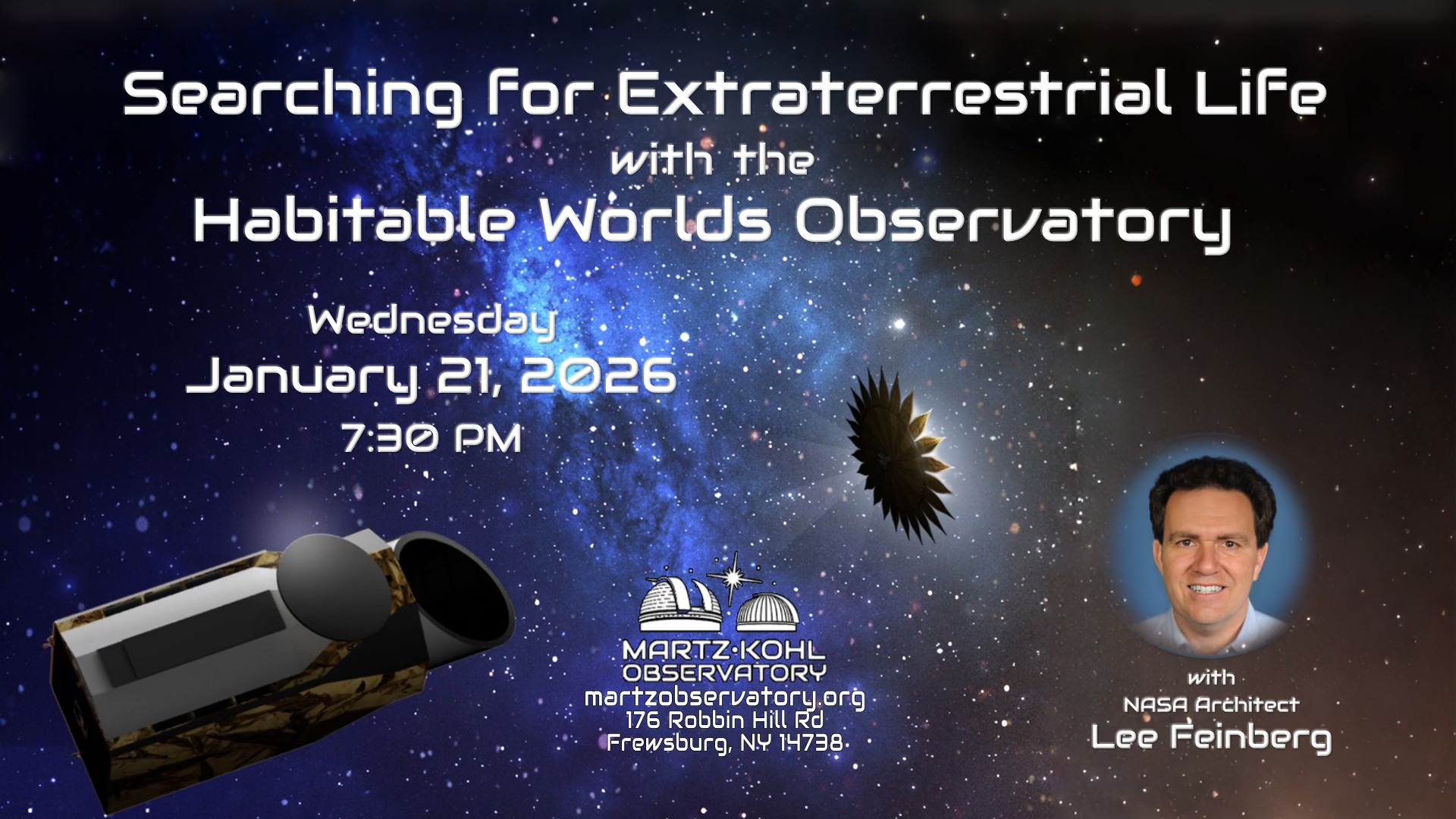
The public is invited to attend a fascinating talk on humanity’s next great mission to search for life beyond Earth. Lee Feinberg, Principal Architect of NASA’s proposed Habitable Worlds Observatory (HWO), will present the science and engineering behind this future flagship telescope on Wednesday, January 21, 2026, at 7:30 p.m. The talk will cover the key and driving science needs, the architectures being studied, and the technologies being used for the HWO. It will also discuss how lessons from previous space telescopes are being factored into the effort.
The Habitable Worlds Observatory is being designed as a massive, next-generation space telescope—often called a “super-Hubble” — that will build on the technologies of the Hubble, James Webb, and Roman space telescopes. The primary goal of the HWO is to directly image Earth-like planets orbiting distant stars and analyze their atmospheres for biosignatures, or chemical evidence of life.
Lee Feinberg brings a wealth of experience from NASA’s most critical space projects. He currently serves as the Principal Architect for the HWO at NASA’s Goddard Space Flight Center. For over 20 years, he was the Telescope Manager and optics lead for the revolutionary James Webb Space Telescope (JWST). Prior to that, he was part of the team responsible for repairing and upgrading the Hubble Space Telescope (HST). Feinberg is a NASA Goddard Senior Fellow and a recipient of the US government’s Presidential Rank Award for his contributions to the JWST.
This talk will be shown on the big screen at the Martz-Kohl Observatory and available online via Zoom. You are encouraged to come to the observatory to virtually meet Lee Feinberg and join in our always lively Q&A after his talk. The observatory is located at 176 Robbin Hill Rd, Frewsburg, NY 14738. If the weather permits, there will be public viewing opportunities. While our lecture room is heated, you should dress for outside weather for tours and viewing. More info: https://martzobservatory.org